
Software for intelligent container management and automated returnable logistics
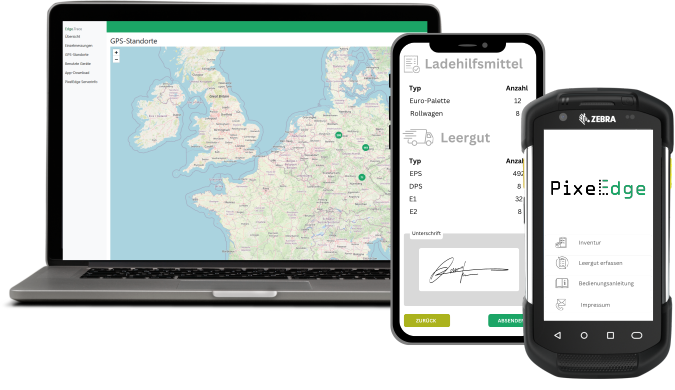
Our platform combines AI-based capture and inventory management in one end-to-end process: fewer manual postings, greater transparency and faster clarification of target/actual discrepancies.
These companies trust PixelEdge

What is container management software?
Container management software manages inventories, movements and responsibility for reusable containers across your processes - from gate capture through to controlling analytics.
Unlike purely manual administration, a modern solution connects operational capture (e.g. app or scanning process), centralized data storage and traceable postings. This reduces media breaks and creates reliable figures for returnable and container cycles.
For PixelEdge, this means capture and management are designed together, so teams spend less time correcting data and discrepancies can be clarified faster.
Transparency
Locations, quantities and movements remain traceable across all involved processes.
Control
Discrepancies and bottlenecks become visible earlier, so operational teams can respond faster.
Documentation
Documented transactions make claim clarification and coordination with partners easier.
From scan directly into inventory - without manual counting
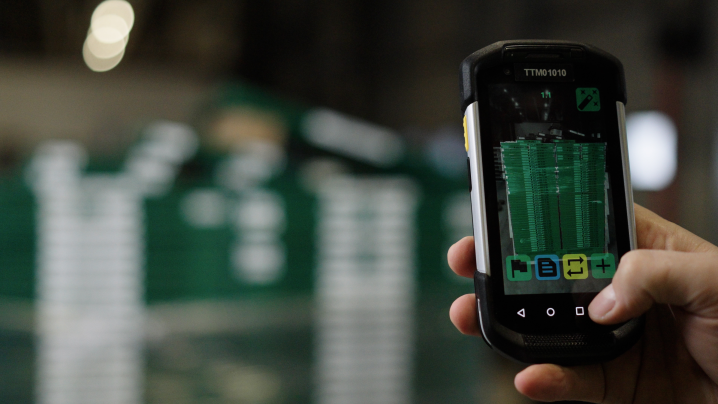
Returnable management software and container management software only work truly efficiently when capture and posting interact seamlessly. This is exactly where the zero-touch data chain comes in.
With Edge.Count and ScanGate systems, quantities and types are captured automatically and transferred into the software. This helps you avoid media breaks between loading dock, warehouse and administration.
- Fewer manual entries and lower risk of errors
- Faster clarification of discrepancies thanks to documentation
- Transparent inventories across locations and processes
- Integration into existing ERP/WMS landscapes
Implementation in three pragmatic steps
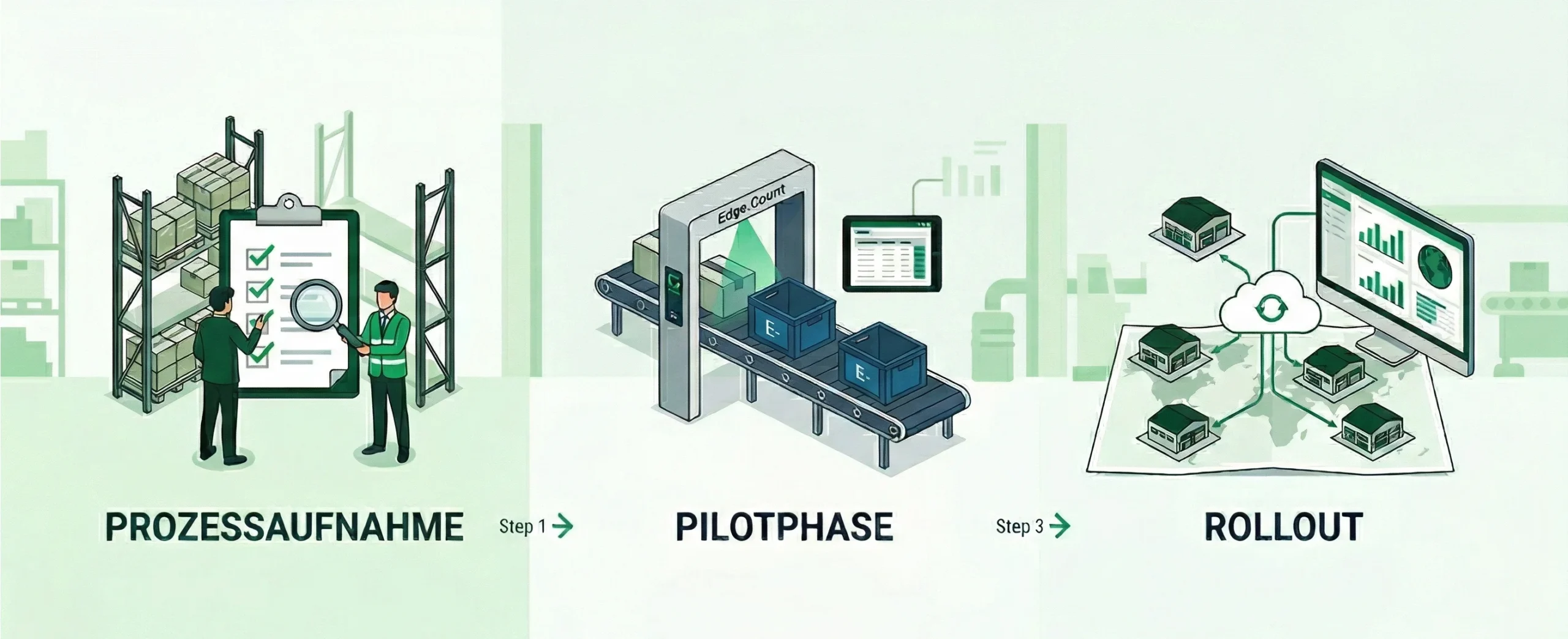
- 1Process assessment:Together, we analyze where counting, documentation and reconciliation happen today.
- 2Pilot phase:Start on selected routes or locations with real container types and clear target/actual checks.
- 3Rollout:Expand to additional locations with centralized analytics and clear responsibility for each process step.
This creates a robust operation quickly, without your teams having to wait months for results.

Das BioBackHaus"With mobile AI counting, container management software and GPS, we became productive in a short time and reduced the workload for our delivery operations, while all locations are consolidated in one analysis."
Organic bakery · Berlin & Brandenburg
Features and automation for container management software
Container management software and returnable management software deliver their full value when capture, posting and analytics work together seamlessly. This solution component is designed precisely for that.
With the combination of Edge.Count, ScanGate and platform logic, data is transferred directly from the process into analyzable inventories. This reduces manual transfers and creates a reliable data basis for operational decisions.
Implementation effort in practice
Implementation effort depends on the project and is based on locations, processes and integrations. In the BioBackHaus reference project, full integration took 2 weeks. View the reference.
Benefits for day-to-day logistics operations
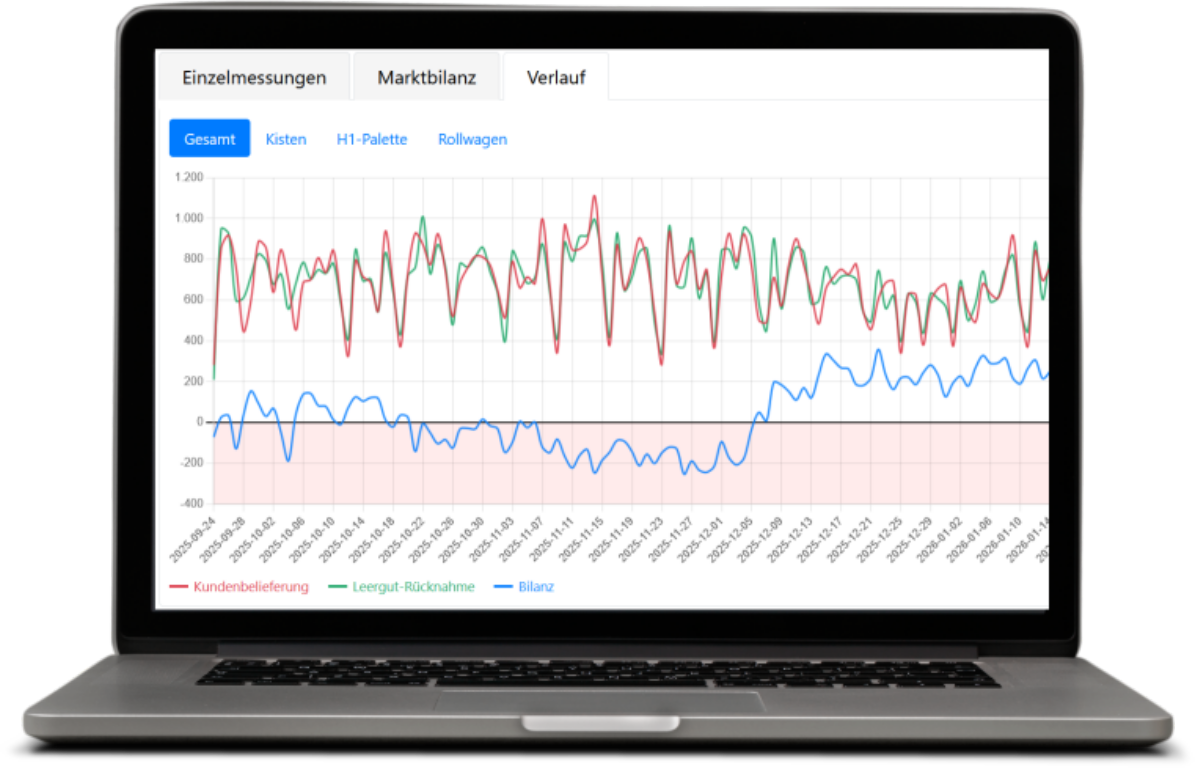
Functions at a glance
The functional scope is designed for operational logistics processes with high container and returnable circulation. The goal is a continuous workflow from capture through to analyzable data.
Real-time inventory overview
View current inventories and movements by location, process or container type.
Transaction-based capture
Transfer data from mobile and stationary capture into the software process in a structured way.
Discrepancy and claim clarification
Trace postings including documentation and process deviations in a targeted way.
History and traceability
Use movement data and transactions in a central history for review and reconciliation.
Analytics and reports
Consolidate KPIs for operational control, dispatching and controlling.
Roles and responsibilities
Map access rights and processes by role - from drivers and warehouse teams to administration.
Export and integration capability
Provide data for downstream processes in ERP/WMS workflows via interface or export.
Scaling across locations
Use one shared model for multiple locations and different container types.
Comparison: standard administration vs. PixelEdge software + AI
| Feature | Standard software | PixelEdge software + AI |
|---|---|---|
| Data capture | Manual entry or scanner-guided individual steps | Automated through Edge.Count and ScanGate processes |
| Error susceptibility | Higher with manual process steps and media breaks | Significantly reduced through AI-supported capture |
| Evidence for discrepancies | Often incomplete or only available with high manual effort | Documented transactions with image reference and history |
| Speed in daily operations | More dependent on manual posting and rework | Faster throughput through an automated data chain |
Relevant solutions and deep-dive content
When introducing software for container and returnable management, capture, automation and practical expertise need to work together. These three resources lead directly into implementation.
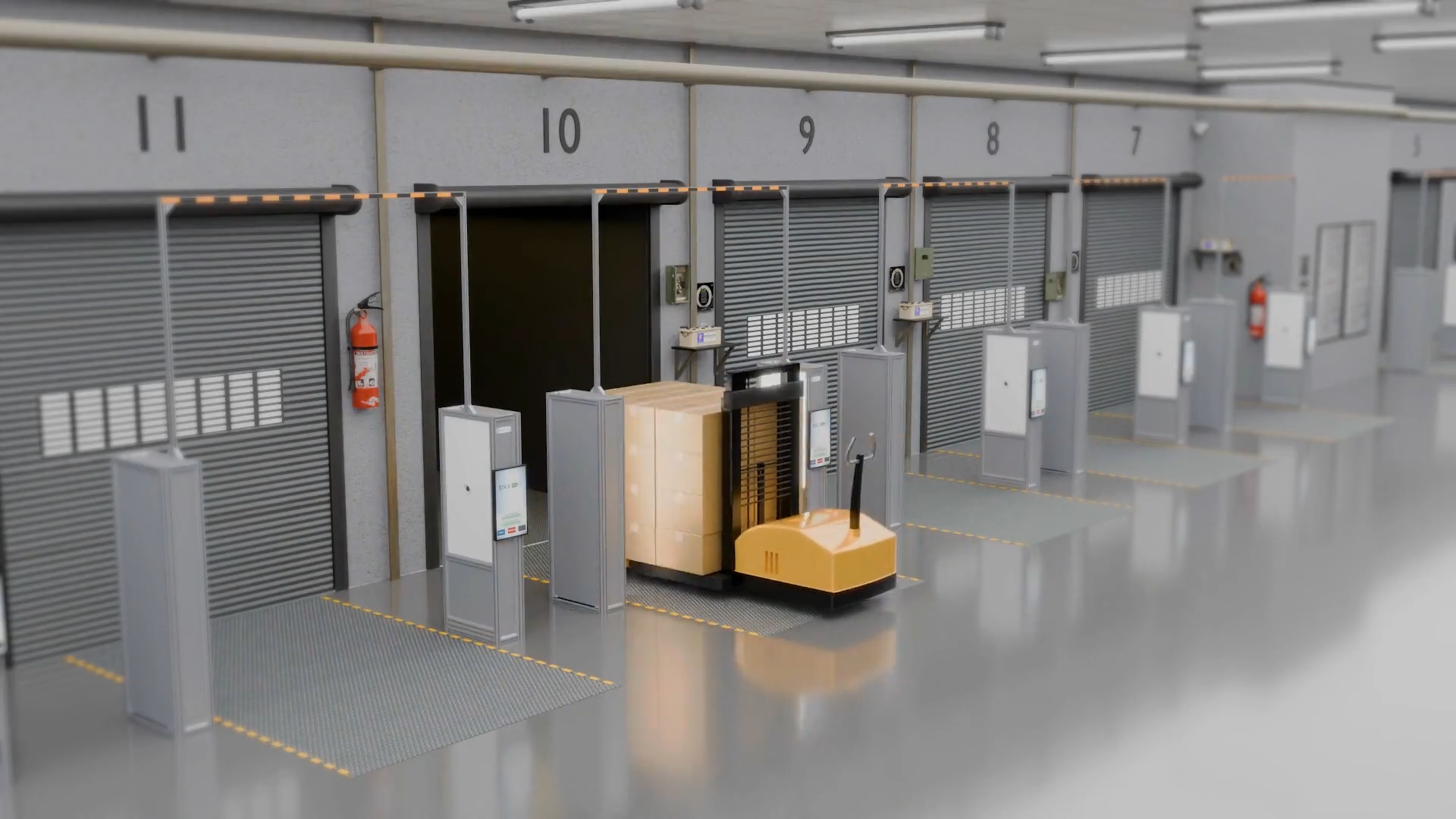
From practice: fast implementation with high operational relevance
In the BioBackHaus reference project, mobile AI counting, container management software and GPS-supported assignment were brought into production in a short time - with a focus on reducing daily workload and creating reliable data for control. View the reference.
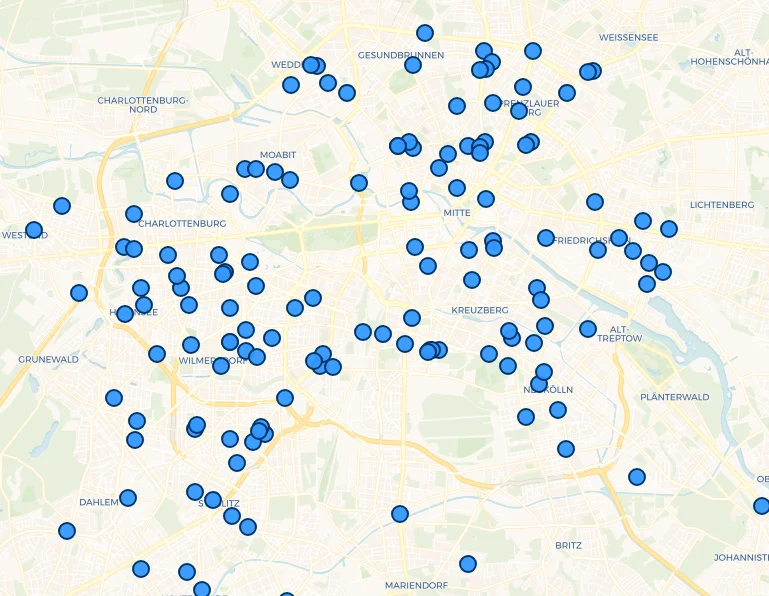
GPS-supported location transparency for containers and returnables
In distributed branch and route networks, the quantity is not the only factor that matters; the exact location is just as important. GPS-supported assignment links stops, handovers and postings more clearly to a specific place.
Customer assignment can be automated through GPS context. This reduces manual selection steps in the process and helps avoid incorrect postings to the wrong customer or location.
This creates a reliable view of the returnable cycle - from on-site capture through to central analysis in the software.
- Locations and movements consolidated visibly in one map
- Automatic customer assignment via GPS instead of manual selection
- Fewer incorrect postings thanks to clearer location and customer context
- Faster clarification of discrepancies through unambiguous location context
- Better basis for dispatching, route optimization and controlling
Integrations and data flow
For reliable container and returnable management, it is crucial that data does not remain trapped in isolated systems. The data flow is set up so operational capture and central analytics work together consistently.
Mobile and stationary capture in operational processes.
Structured transfer into the software with clear transactions.
Centrally analyze inventories, discrepancies and responsibilities.
Transfer data into downstream systems and reports.
Interfaces to ERP/WMS processes
Integration paths are adapted to your process landscape on a project-specific basis, so master data and movement data remain consistent.
API and export workflows
Depending on the architecture, data can be transferred into downstream processes via API or defined export formats.
Data ownership and traceability
Transactions remain documented and auditable, so operational teams and controlling work from the same data basis.
Scaling without process disruption
The approach can be expanded to additional locations and container types without rebuilding the core process.
Use cases and conclusion
Software for container and returnable management delivers the greatest value wherever high circulation volumes, multiple stakeholders and recurring discrepancies come together. This applies not only to branch and fresh goods logistics, but also to production sites, automotive networks with small load carrier cycles and cross-location supply chains.
Conclusion: when capture, software and analytics work together, manual effort in daily operations drops significantly. At the same time, data quality, traceability and controllability increase across the container and returnable cycle - from the loading dock to controlling.
Frequently asked questions about container and returnable management software
Which containers and load carriers can be managed?+
Typically, reusable containers such as small load carriers, crates, pallets, roll cages and other load carriers can be mapped in one shared model. The decisive factor is that container types, posting logic and responsibilities are clearly defined for each process.
Is barcode or RFID capture possible?+
Yes. Depending on the process, barcode scanners, mobile capture and stationary scan points can be combined. RFID scenarios are also possible when the infrastructure and use case are designed for it.
How does the data get into the software?+
Depending on the process, data can be transferred automatically from mobile capture (Edge.Count) and stationary capture points (ScanGate). This reduces manual posting effort.
Can the solution be integrated into ERP or WMS processes?+
Yes. Integrations can be implemented on a project-specific basis, for example via APIs or coordinated export/import workflows.
How is real-time transparency over inventory and location created?+
Through direct posting of inbound, outbound and transfer movements in operational processes. This makes inventories, movements and open discrepancies visible quickly and available for dispatching and controlling analytics.
Is there digital account management for customers, suppliers and freight forwarders?+
Yes. Accounts can be managed by quantity and, depending on the setup, also at object level. This makes exchange processes, discrepancy clarification and coordination with partners much more traceable.
Are container management and returnable management the same in your software?+
In many projects, returnable management is a central use case of container management. The software maps both perspectives in one shared data model.
What effects on costs, losses and circulation times are realistic?+
Typical effects include reduced losses, less manual rework and more stable circulation. The exact impact depends on data quality, process discipline and the degree of integration, and becomes transparently measurable in the pilot.
How much implementation effort is required and how fast is integration?+
The effort depends on process scope, locations and integration level. In the BioBackHaus reference project, full integration took 2 weeks. View the reference.
Which teams benefit the most?+
Especially logistics management, warehouse teams and operational owners who want to manage inventories transparently and clarify discrepancies faster.
Is there a demo for our processes?+
Yes. In a demo, your process steps are reviewed and a suitable setup of software and capture components is presented.
Request a software demo for container and returnable management
We review your current workflow and show how capture, inventory management and documentation processes can be combined efficiently with PixelEdge.