
OCR for Industry: Introduction to OCR Technology – Problem and Solution
OCR for industry has fundamentally changed the way we work with documents. Optical Character Recognition (OCR) enables the automatic conversion of printed or handwritten text into machine-readable text.
Manual data entry is time-consuming, error-prone and costly. Companies that need to process large volumes of documents and marked parts face significant challenges. Typing texts from printed or handwritten documents as well as manually recognizing directly marked parts and best-before dates is inefficient and can lead to data loss or distortion.
Flexibility and Speed of Learning
A special feature of our OCR solution is its impressive adaptability. To demonstrate this, we taught our system to recognize Klingon on carton labels. Yes, you read that correctly – Klingon!
While this was of course a tongue-in-cheek experiment, it impressively demonstrates how flexibly and quickly our system can learn new fonts and languages. Whether it is exotic alphabets, special fonts or industry-specific symbols – our OCR system can be trained on them in the shortest time.

Beyond Printing – Character Recognition on Any Surface
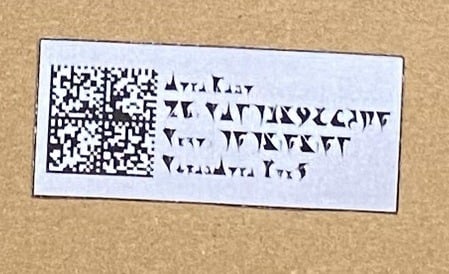
Klingon label on carton
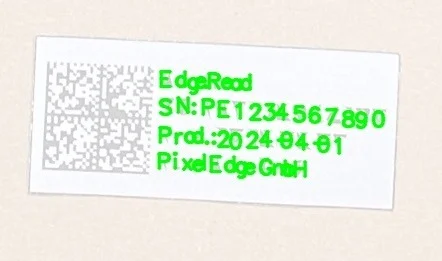
AI reliably recognizes the text
Whether embossed, stamped, laser-etched or written in distant galaxies: We train our AI models on your specific surface. Where standard software gives up, PixelEdge starts.
The Klingon example shows: If the AI can learn a fictional, complex language, real industrial challenges are no problem. In many industries, text is not classically printed but part of the material surface – and that is exactly what our systems are designed for.
Character Recognition – Even When Not Printed:
Metal Processing & Automotive
Dot peening for VIN numbers, laser engravings on reflective surfaces, cast markings and punch stamps – characters directly in metal.
Rubber & Plastics
Tire markings (black-on-black), cable stampings in insulation, injection molding markings with batch numbers or recycling codes.
Pharma & Packaging
Blind embossing (Braille), punch-through embossing on cartons or aluminum blisters, codes in seal seams of plastic bags.
Construction & Heavy Industry
Burn stamps on wood (e.g. IPPC pallets), weld bead coding, stone and concrete engravings on precast elements.
Stamping & Embossed Parts
Raised or recessed characters in sheet metal, films or carton – without color application, only through deformation.
Textiles & Glass
Embroidered logos or numbers, etched serial numbers on glass panes – barely visible, but recognizable.
Solution: Optical Character Recognition (OCR)
Optical Character Recognition (OCR) offers a solution to these problems by converting printed or handwritten text into machine-readable data. OCR technology uses advanced algorithms and machine learning to recognize and digitize text, including specific tasks such as recognizing directly marked parts and best-before dates on packaging.
- ✔ Conversion of printed and handwritten text into machine-readable data
- ✔ Algorithms and AI for precise text recognition and digitization
- ✔ Direct markings on components and packaging
- ✔ Best-before date recognition on packaging for production and logistics
How Does OCR Work?
OCR systems scan documents and analyze text structures. Modern OCR software uses neural networks to recognize various fonts and sizes. The technology goes through several steps, including preprocessing, text recognition and post-processing, to ensure high accuracy. Special algorithms enable recognition of text on various surfaces, including direct markings on components and packaging.
1. Preprocessing
Image optimization, cleaning and preparation of data for text recognition – e.g. contrast adjustment, noise removal and thresholding.
2. Text Recognition
Neural networks analyze text structures and recognize characters, fonts and sizes – also on various surfaces such as components and packaging.
3. Post-processing
Validation and error correction of recognized data to ensure high accuracy and reliable machine-readable output.
Application Areas of OCR
Digital Archiving
OCR is used for digitizing archives and libraries.
Document Management
Companies use OCR to automate invoice processing and contract management.
Data Extraction
OCR helps extract data from forms and tables.
Industrial Applications
Recognition of directly marked parts for quality assurance and traceability.
Food Processing
Automated recognition and tracking of best-before dates on packaging.
Advantages of OCR
- ✔ Time savings: Automated data capture significantly reduces time expenditure.
- ✔ Cost reduction: Less manual work lowers operating costs.
- ✔ Accuracy: Reduced error rate compared to manual entry.
- ✔ Accessibility: Facilitates access to digital data archives.
- ✔ Efficiency: Specific industrial applications improve efficiency and accuracy in production.
Ready for Intelligent Text Recognition?
Schedule a demo and discover how our OCR solution automates your processes and ensures quality.
More solutions: Print Inspection · 3D Snap Ring Inspection · Surface Inspection