
Counting reusable load carriers with AI – visual counting: Rick LeBlanc profiles PixelEdge
After an interview with PixelEdge, Rick LeBlanc (publisher of PackagingRevolution.net / Reusable Packaging News) covered our solution. Below is an English summary: camera- and AI-based visual counting for pallets, roll cages, and returnable crates—with digital proof.
Introduction
Trade journalist Rick LeBlanc featured PixelEdge and our technology for automatic counting of returnable load carriers in his piece on PackagingRevolution.net (March 2026; article title: Camera-Based AI Aims to Automate Returnable Asset Counting). It was based on a conversation with CEO Markus Weber. Below we summarize the main points and show how you can count reusable containers with AI—and how digital records support better tracking across the supply chain.

“Retail supply chains rely on millions of reusable transport assets, from pallets and roll cages to bakery trays and produce crates. Yet many of these items are still counted manually at stores, warehouses, and return depots. The process is slow, repetitive, and prone to error.”
“A young German technology company, PixelEdge, believes computer vision and artificial intelligence can help automate that task.”
Based in Hanover, PixelEdge builds camera-based systems and mobile apps that count and document returnable load carriers automatically—the technical foundation for more accurate inventories and fewer disputes in the chain.
Source & status: The English article on PackagingRevolution.net is dated 20 March 2026. This page is an editorial summary; wording or details may differ if the original is updated.
Manual counting as the bottleneck
In many retail logistics operations, drivers must manually count returnable assets when collecting them from stores. The counts are often entered into mobile applications or paperwork before the truck leaves. Markus Weber, managing director of PixelEdge, describes the starting point:
“We started working on this topic a few years ago with one of the biggest retailers in Germany,” said Markus Weber, managing director of PixelEdge. “They had all kinds of returnables that needed to be counted, including roller cages, dollies, pallets, different crates, and drivers had to count everything manually.”
According to Markus Weber, that process can repeat several times along the supply chain.
“Whenever the driver goes to a supermarket and takes back the returnables, they need to count everything,” he explained. “Sometimes the assets are counted again at the logistics hub as a second check, and sometimes even a third time. Nothing is fully digitalized.”
The result is lost time and inconsistent data. Drivers may have dozens of different items to count, ranging from pallets and crates to specialized trays. At busy retail locations, taking an extra minute or two to recount stacks can disrupt schedules, and mistakes can lead to disputes or asset losses later in the supply chain. PixelEdge’s approach is to replace manual counting with AI-based image recognition.
Counting reusable containers with AI – how it works
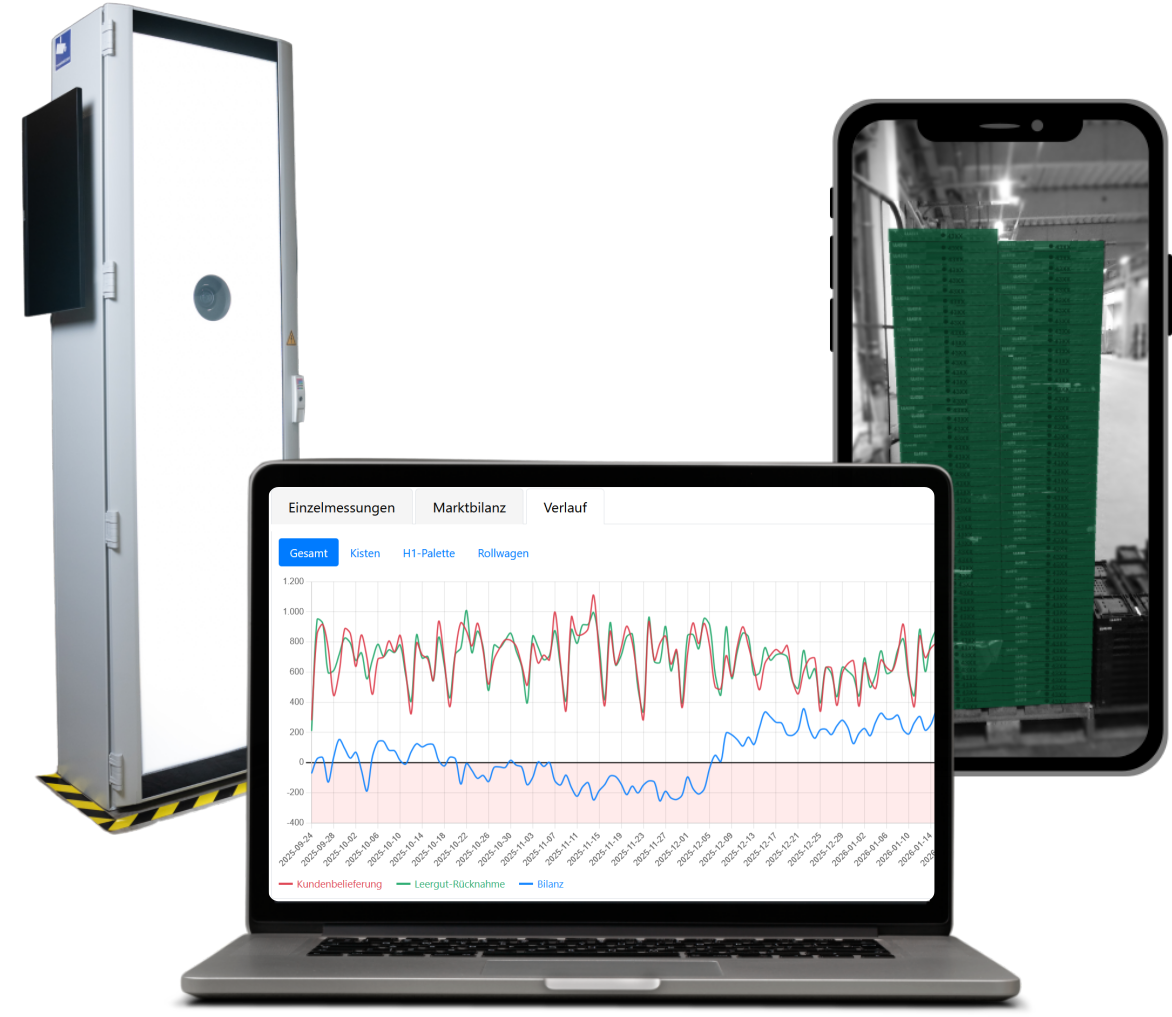
The company’s technology relies on cameras and machine-learning models trained to recognize reusable containers and pallets. Using a mobile phone or camera system, a worker can take an image of stacked returnables. The system then identifies the type of container and automatically counts the items. PixelEdge says the software can recognize multiple container types and operate even when assets are partially obscured.
“We do everything with AI,” Weber said. “It’s basically pattern recognition on steroids.”
“For our software, it doesn’t matter if there is wrap over the stack or if the crates are not perfectly aligned,” Weber said. “As long as you can see it with your eyes, it is possible to count it.”
The system can also identify packaging elements, such as straps that might block part of the view, and still estimate the underlying quantity. The next section shows how capture, counting, and analysis come together in practice—with the building blocks Edge.Count and Edge.Trace.
Two building blocks: Edge.Count and Edge.Trace
PixelEdge currently offers two main software components. The Edge.Count application performs the image capture and counting. A user simply photographs the stacked assets, and the system calculates the quantity. The results are then sent to Edge.Trace, a backend platform that stores and analyzes the counting data.
“Every measurement comes into our backend,” Weber said. “You can see where the counting happened, how many items were counted, and the pictures that were taken.”
The platform provides a digital record of asset movements and inventory counts across locations.
For operators managing reusable assets, that visibility can help identify discrepancies or potential leakage points.
— PackagingRevolution.net (article text)
“For example, a bakery might lose thousands of crates over the course of a year,” Weber said. “With the data you can start to see where items are not coming back.”
Use cases and outlook
The company initially developed its technology while working on logistics automation projects related to the German retail sector. Markus Weber said the early focus was on logistics hubs where large volumes of returnable containers flow through daily operations. However, warehouses often have dozens of loading gates, meaning that installing dedicated scanning hardware at each location could become expensive. To address that challenge, PixelEdge developed its mobile application.
“Customers said it’s a nice solution, but they would need too many scan gates,” Weber said. “So we decided to develop an app where you can simply take a picture and the crates are counted.”
The approach allows companies to deploy the technology without installing large numbers of fixed scanning systems.
In addition to container counting, PixelEdge is exploring applications in pallet management. The company is currently working on software models designed to recognize pallet stacks and estimate pallet quality grades.
“In Germany we have pallet grading from A to C,” Weber said. “A is very good quality and C is very poor quality. Our next step is to see if we can estimate the grading from images.”
“If you take a picture of a stack of pallets, you could get an overall grading estimation,” he said. “It may not be perfect, but it is better than doing no grading at all.”
Because many of PixelEdge’s projects involve large retailers and logistics operators, deployment timelines can be lengthy.
“Getting inside big companies takes time,” Weber said. “You have to go through privacy reviews, data storage questions, and all kinds of approvals.”
“These processes take longer than we expected,” he said. “But once they are completed, the systems can be rolled out much more easily.”
While the company’s initial focus is on European retail logistics, Markus Weber believes the technology could also have strong potential in North America. Reusable assets are widely used in bakery, produce, and retail distribution networks, he noted, yet manual counting remains common.
“In North America there are also many reusable assets,” Weber said. “And our solution is easy to implement, so it could have an impact there as well.”
For now, the company’s priority is to refine its models, expand the library of recognized returnable assets, and work with early customers to validate the technology in real-world logistics operations.
“We want to get into the retailers first,” Weber said. “Then we will expand and see where our solution can have the biggest impact.”
We at PixelEdge are glad that Rick LeBlanc’s reporting draws attention in Canada and North America: we appreciate when a recognized industry voice highlights our work and underscores how important reliable counting of returnable load carriers is beyond Europe alone.
Frequently asked questions: counting reusable containers with AI
What does camera-based AI mean for counting? +
A camera (e.g. in a smartphone or at a station) captures an image of the returnable containers. AI automatically detects container type and quantity—without manual counting. It is faster and less error-prone.
Which containers can the AI count? +
Edge.Count can recognize and count various returnable containers—for example roll cages, pallets, crates, bakery trays, produce totes—provided the types have been trained in the system. New types can be added.
What is the difference between Edge.Count and Edge.Trace? +
Edge.Count is the app for taking photos and automatic counting. Edge.Trace is the platform where all count results are stored, visualized, and analyzed—including location, time, and image.
Does counting work with stretch wrap or messy stacks? +
Yes. The AI is trained to detect and count visible containers even with film, strapping, or disordered stacks, as long as a human could recognize them in the image.
Who is Rick LeBlanc? +
Rick LeBlanc is founder and publisher of PackagingRevolution.net and has reported for more than four decades on pallets, reusable packaging, and supply-chain logistics—including for Reusable Packaging News, Western Pallet Magazine, and Forklift News. He is co-author of Pallets: A North American Perspective (20th Anniversary Edition, 2023) and advises the Center for Packaging and Unit Load Design at Virginia Tech.
Read his article on PixelEdge here: Article on PackagingRevolution.net →. This blog post summarises the story and adds context for logistics teams in Europe and beyond.
See counting reusable containers with AI in action
In a no-obligation demo we show Edge.Count and Edge.Trace and how you can count returnable containers with AI and automate counting workflows.